
The Man Beethoven Trusted — and History Forgot

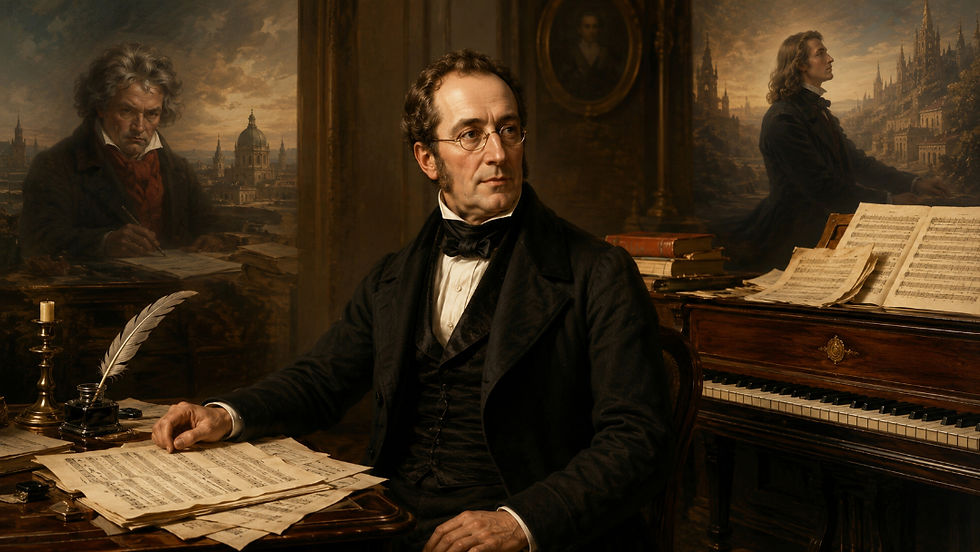
I recently read Beyond The Art of Finger Dexterity: Reassessing Carl Czerny, edited by David Gramit (Cambridge University Press), one of the few recent academic books devoted entirely to Czerny.
And I must say: it helped me understand Carl Czerny more than I could have imagined.
Or, to put it differently: it opened a perspective that was quite shocking.
Apparently, almost nobody really knows the man today. Not who he truly was, not his importance in history, and not his talent as a musician and composer.
In a way, it is almost unbelievable how someone who a) occupied such a pivotal position in the history of piano playing, b) was one of Beethoven’s most important pupils and one of his rare lifelong friends, c) shaped the nineteenth-century piano world not only through his etudes, but also by being the teacher of Franz Liszt, and d) apparently had a real talent for composition, ended up falling between the cracks of the history books.
And where a little bit of “Czerny” does appear between the pages, we usually do not find him worth looking at for very long.
The connections with Beethoven and Liszt alone should have been reason enough for a substantial biography.
But apparently, even that is not so simple. Because it seems that we do not know all that much about his life.
Let us not forget that he lived in the censored and controlled post-Napoleonic Vienna of Metternich. The latter had built something very close to a police state, whose basic idea was to remain modest above all: not to think, invent, do, or even write down anything revolutionary.
Vienna would isolate itself from the world. Also musically.
The Viennese were served their daily waltzes, and with the exception of Beethoven and also Schubert, to my great surprise, who were allowed to write innovative music, Paris and London were handed musical leadership on a silver platter. As a young boy, Mendelssohn no longer went to Vienna on his first great journey, as Chopin still did, but to Paris. Imagine: he could still have met Beethoven while he was alive. What letters that might have produced...
In any case, Czerny accepted the logic of Metternich’s world. He wrote what was expected of him. He stayed within the musical lines.
That is to say: that is what he did publicly.
In his study, he worked on symphonies, cantatas, string quartets, and similar works, knowing that they would probably never see the light of day. Works which, if I may trust the discussions in Gramit’s book, are compositions that would place him in the upper regions in the nineteenth century, far higher than his current reputation suggests. Related to late Beethoven, and pointing towards Liszt and Wagner, Czerny here seems to fulfil a unique bridging function between them.
And much of it still exists largely in manuscript today. Because if there is one thing I have learned in my tempo research, it is this: it is very difficult to change general perceptions. That is true for our WBMP. And it is true for Carl Czerny. As if the classical music world has enough works from the past... I truly do not understand this general lack of interest for something new.
In any case, Gramit’s book opened my eyes to a Carl Czerny I did not know. And since I read it in the middle of the recording sessions for his Op. 299, The School of Velocity, this famous collection of etudes suddenly appeared in a different light as well. I already found it pleasant to play. These are rock-solid etudes. But I now looked at them with different eyes. My recent video about the “simple” C major opening etude came directly out of that experience.
And where Op. 299 was already symbolically important for our tempo research — watch the Kickstarter video if you have not yet heard me speak about this — this production suddenly became, at least for me, even more important to do. Because if we can make a case for Op. 299, both musically and, in this case perhaps even more importantly, on an excellent pedagogical level, this little CD box may perhaps play a role as a small catalyst for renewed attention to Czerny.
Who knows how these things go?
By the way, yesterday this Kickstarter received the “Project We Love” label! That is something we have been proud to receive a few times before. And now also with our Carl Czerny.
The campaign stands today at 94%.
Maybe this is the moment to bring that small missing piece of the puzzle across the 100% line?


Comments